Namkaran Sanskar : How Name Shapes Your Life
Author: Dr. Anadi Sahoo
Issue: Jan-Feb 2026
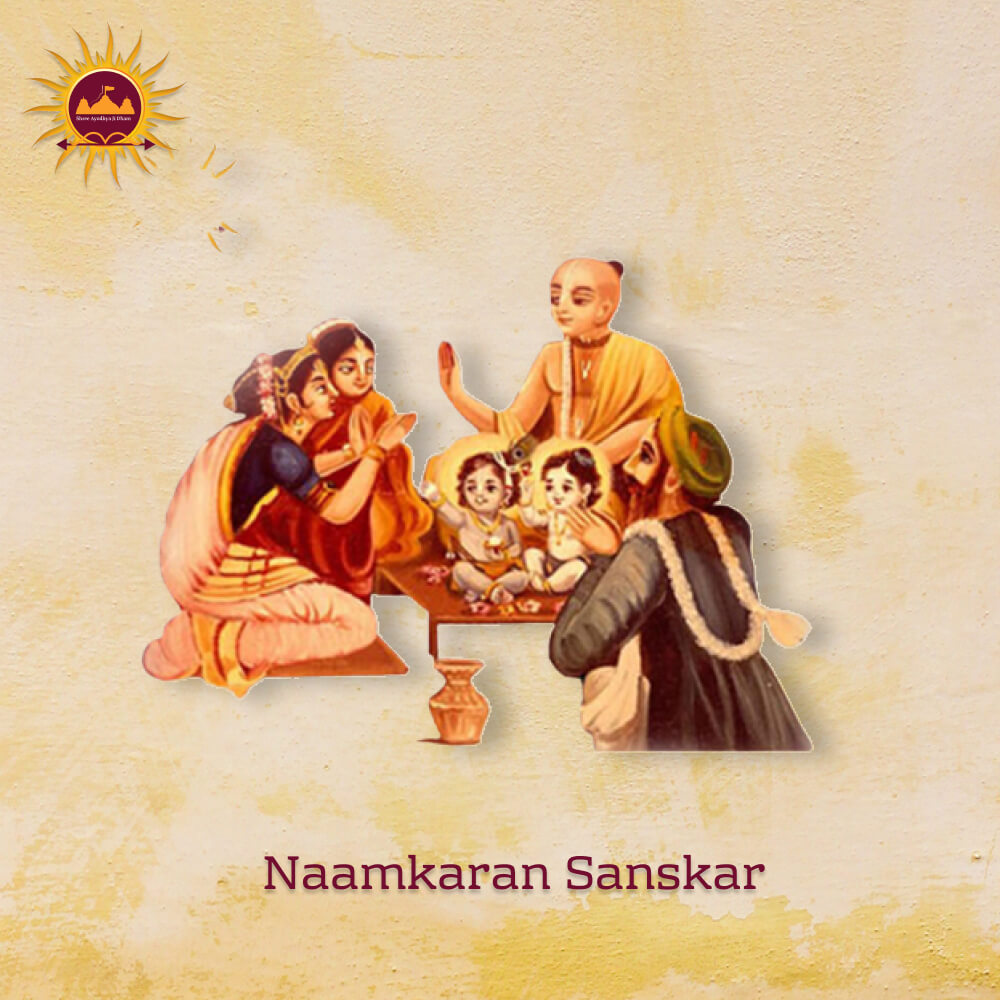
Names and language are identity markers; when they remain pure, the civilization stays strong.
Namkaran, the fifth of the sixteen Hindu Sanskaras, is a sacred rite that does far more than assign a name; it inaugurates a newborn's identity, linking them to their lineage, gotra and dharma.
This ceremony reflects the Hindu dharmic tradition and the parents’ commitment to raise the child with spiritual awareness and values.
Namkaran Sanskar (Grihya Sutra)
तस्माद् पुत्रस्य जातस्य नाम कुर्यात् पिता नाम करोति।ShatapathaBrahmana)
(Therefore, the father should give the name to his child after birth).
Mantras invoking deities, auspiciousness and protection are chanted during the naming, including Agni and Varuna-related hymns, such as: ॐ अग्नये स्वाहा, ॐ वरुणाय स्वाहाwhich symbolically purify and bless the child with divine energies. Specific prayers asking for the child's well-being, virtues and longevity are recited alongside the chanting of the selected name into the child's ear by the father or priest.
The Namkaran ceremony is generally performed on the 11th or 21st day after birth, or on the nearest auspicious day like the first full moon. It marks the child's identity and social acceptance, involving bathing, dressing the infant and publicly announcing the name.
A name is not just a sound, it is a carrier of energy. The act of naming is an imprint on the child's consciousness, shaping their inner qualities, behavior and destiny. It is traditionally performed with rituals including purification and invocation of deities, aligning the child with cosmic energies for blessings and good fortune.
As said in the Chandogya Upanishad, Name is the very basis of speech, meaning that one’s cultural direction and values are shaped by the name itself.
In Vedic tradition, names were chosen with consideration of nakshatras and planetary positions; even today names should be placed within that sacred framework.
Astrologically, Namkaran holds great significance. According to Sage Parashara, the chosen name should harmonize with key chart factors like the Lagna lord or strongest planet, as planetary sounds govern specific phonetics.
Names are also linked to Nakshatra deities. The child's birth nakshatra (lunar mansion) guides the choice of the first sound or syllable of the the name, which corresponds to the nakshatra's prescribed syllables like Cho for Ashwini’s third pada. For example, Kartik for Krittika nakshatra and Narendra for Jyestha ensuring divine qualities resonate throughout life.
Thus, a name can embody combined planetary influences, with the dominant syllable shaping personality traits. Scientific studies show that the sounds in names can influence how personality traits are perceived and possibly how individuals behave.
These scientific studies echo the traditional views: a West Virginia University study found that names dominated by Mars sounds tend to foster bold, assertive personalities, while those with Moon sounds may have fluctuating moods.
Research suggests that the sound structure of a name influences how personality traits are perceived.
Names with sharp or abrupt sounds (eg. Mars-dominant sounds) are commonly linked to extraversion, boldness and assertiveness, whereas names with softer, flowing sounds (eg. Moon-dominant sounds) are linked with agreeableness, conscientiousness, warmth and emotional sensitivity.
This indicates that people unconsciously attach symbolic meaning to sound patterns when forming personality impressions.
For example, sharp sounds tend to be associated with outgoing, energetic, blunt or bold personalities, while softer sounds convey gentleness, emotional depth and warmth. This explains why some names feel assertive the moment we hear them, while others feel calm or comforting. The sound itself carries a subtle emotional signal, influencing how a person’s nature is intuitively perceived.
• Saturn sounds often correspond to lives of responsibility and challenge, evident in figures like Bhishma and Bheem.
• Venus sounds inspire artistic and romantic qualities but entwine the individual's destiny with marriage. Even surnames modulate these influences; a light name coupled with a weighty surname alters cosmic balance, exemplified by Sachin Tendulkar.
• Mercury, as the planet of language and identity, governs how we respond to our name. If Mercury faces afflictions from shadow planets or the 8th house, issues of self-confidence and fame may arise. This underlines that pronunciation affects the mind far more than spelling, as the mind vibrates with sound rather than script.
The brain responds uniquely to hearing one's own name compared to others, affecting arousal and attention, highlighting the psychological impact names hold beyond mere labels.
Research has explored correlations between speech sound qualities and personality traits like neuroticism, extraversion and psychoticism. It reveals that vocal characteristics including phoneme frequencies & patterns may reflect or influence behavioral dispositions.
If you name your child with influences imported from foreign and Western cultures, you are essentially raising a generation that will forget its true identity and instead lean toward unrefined types cultures through blind imitation of modernity.